

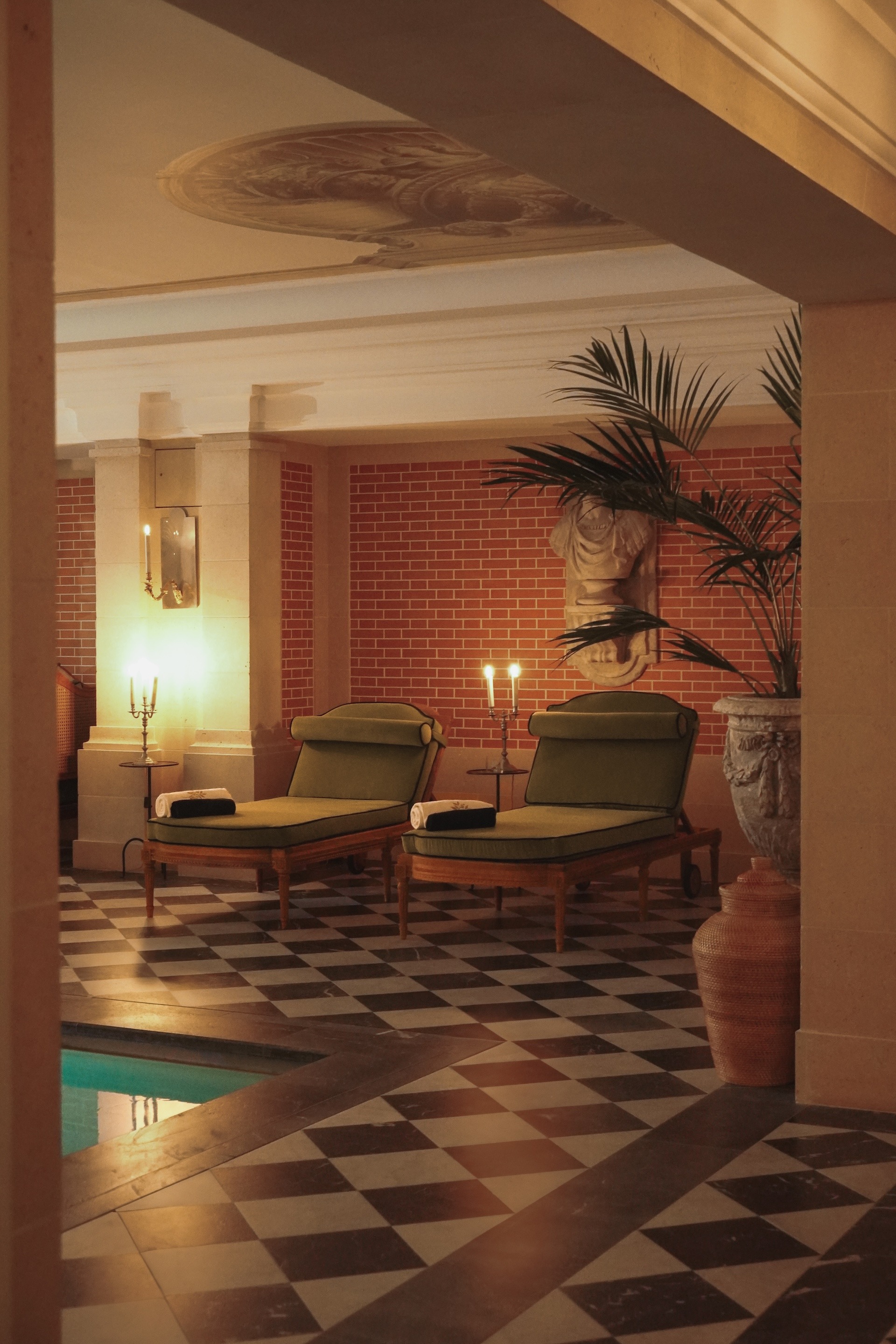
In Venice, silence is a rare commodity…
by Pascal Iakovou for Luxsure
“In Venice, silence is a rare commodity. It is negotiated, circumvented, invented. On the island of Giudecca, away from the tourist crowds, Airelles Palladio introduces a different sense of time: that of a 1,700-square-metre space entirely dedicated to wellness, spread over three levels and opening onto Mediterranean gardens.
The project is not limited to the addition of facilities — hammam, Finnish sauna, Japanese Iyashi Dome, yoga studio — but is based on a vertical layout that segments the experience. Each floor becomes a sequence, a rhythm. The body moves as much as it comes to rest.
The layout across three 16th-century buildings, restored within an estate of around one hectare, imposes a structural constraint: working with the existing structure. Here, the spa does not assert itself as a standalone space but as an interior extension, integrated into the historic architecture. The walls already bear a memory; the project inscribes a new function within them, without any visible break.
Guerlain’s intervention introduces a precise technical dimension. The protocols are not described as a series of standardised movements but as systems. Aqua Venezia is based on a Welnamis water mattress, which works on bodily perception through micro-oscillations. Terra Venezia uses a quartz table, a material chosen for its thermal properties and its ability to diffuse heat in a stable manner. Other treatments incorporate movement—that of a gondola—or sound, inspired by Murano glass. Together, they form a system in which each element alters sensory perception.
The Hair Spa, entrusted to Rossano Ferretti, extends this personalised approach. The ‘Metodo Cut’ does not standardise the cut; it adapts to the hair’s natural structure. The technique is based on a preliminary reading of the hair’s movement, followed by an intervention that accompanies rather than constrains. This approach, inherited over three generations, is part of an Italian tradition where the gesture remains central.
The decision to incorporate four pools, including an indoor one dedicated to the spa, also alters the relationship with water. In Venice, water is omnipresent but rarely accessible as a space for retreat. Here, it becomes a regulating element, a tool for transition between the stages of the journey.
Beyond the architectural structure, Airelles is pursuing a broader strategy: to place Venice on a contemporary map of well-being. The city, historically focused on commerce and representation, is also becoming a destination for extended stays, structured around retreats and personalised programmes. The spa thus acts as a pivot, linking hospitality, care and the use of time.
With forty-five rooms, including seventeen bedrooms and twenty-eight suites, as well as a private villa and a 450-square-metre presidential suite, Airelles Palladio remains an intimate establishment. The spa, by virtue of its size, almost becomes its centre of gravity.
In this setting, luxury lies not in the accumulation of facilities but in the opportunity to step away from the pace of city life. In Venice, this is less about comfort than a form of precision.”
Read the rest of the article on the website